
High-Temperature Tape in SMT & Reflow Soldering: The Complete Process Guide for Electronics Manufacturers
Introduction: Your Insurance Policy Against Reflow Disasters
A single reflow profile mistake can destroy thousands of dollars in PCB assemblies. High-temperature tape is your insurance policy—but only if you choose the right one. In the fast-paced world of Surface Mount Technology (SMT), the margin for error is virtually zero. When PCBs enter the reflow oven, they are subjected to extreme thermal shock. Standard masking tapes will melt, leave conductive residue, or peel off, leading to solder bridging, short circuits, and costly board rework.
Selecting the correct polyimide tape for SMT and reflow soldering is not just about heat resistance; it is about understanding the intricate balance of thermal stability, adhesion retention, and clean removability. This comprehensive guide will walk you through the reflow process, help you understand how polyimide tape performs under extreme conditions, and provide actionable criteria for selecting the perfect tape for your manufacturing line.
Why SMT Processes Demand Specialized High-Temperature Tape
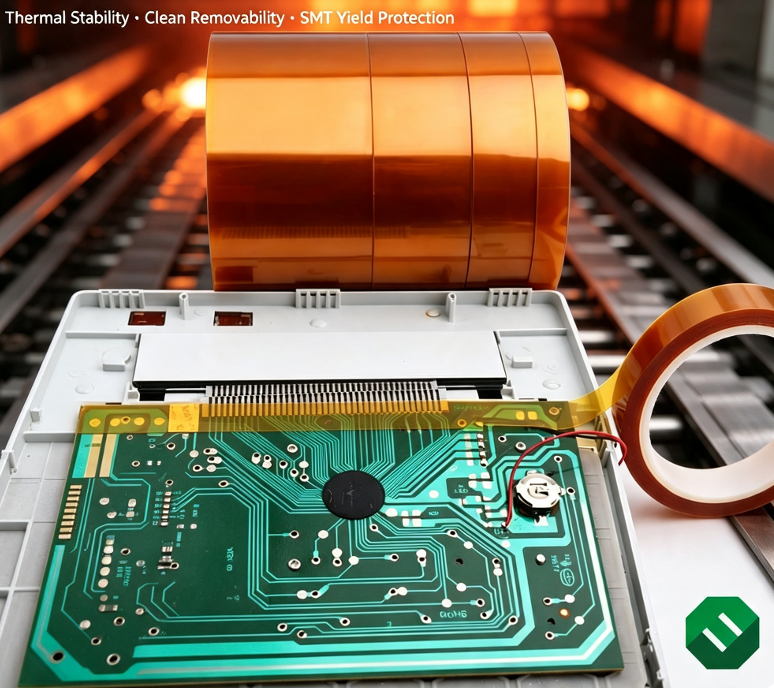
SMT and reflow soldering environments are uniquely hostile to adhesives. Unlike standard industrial masking, SMT requires a tape that can withstand rapid temperature spikes, maintain a secure bond on complex geometries (like gold fingers or component edges), and release cleanly without leaving any residue that could interfere with electrical conductivity.
Standard tapes fail in SMT for three primary reasons:
1. Adhesive Migration: Heat causes the adhesive to flow into solder pads or connectors.
2. Thermal Degradation: The backing film shrinks or melts, exposing areas meant to be protected.
3. Residue Formation: Degraded adhesive leaves behind carbonized or sticky remnants that require aggressive chemical cleaning, risking damage to the PCB. Polyimide (Kapton) tape is the industry standard for SMT because its molecular structure remains stable at temperatures far exceeding typical reflow profiles.
Reflow Soldering Process Overview
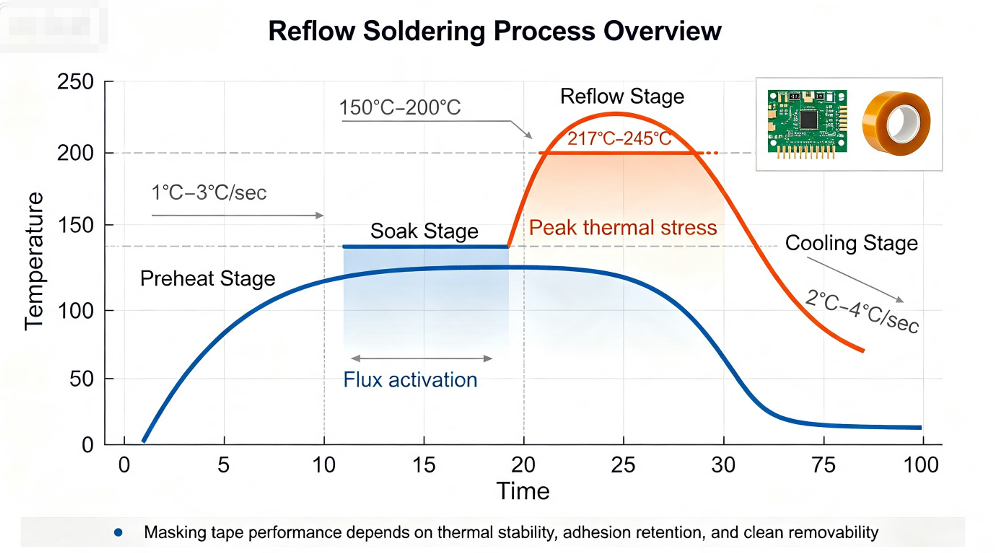
To select the right tape, you must understand the thermal journey of a PCB. A standard reflow profile consists of four distinct stages:
1. Preheat Stage: The PCB temperature rises gradually (typically 1°C to 3°C per second) to activate the flux in the solder paste and minimize thermal shock.
2. Soak Stage: Temperatures are held steady (usually between 150°C and 200°C) to allow solvents in the flux to evaporate and ensure uniform heat distribution across the board.
3. Reflow (Liquidus) Stage: The peak of the process. Temperatures rapidly exceed the melting point of the solder alloy (typically 217°C to 245°C for SAC305). This stage lasts only 30 to 90 seconds but exerts the most severe thermal stress on masking tapes.
4. Cooling Stage: The board cools at a controlled rate (2°C to 4°C per second) to solidify the solder joints and prevent metallurgical defects.
Temperature Requirements at Each Stage
Understanding the exact temperatures your tape will face is critical. Below is a breakdown of standard reflow requirements:
Reflow Stage | Temperature Range | Duration | Tape Requirement |
Preheat | 25°C – 150°C | 60 - 120 seconds | Initial adhesion must hold without oozing |
Soak | 150°C – 200°C | 60 - 120 seconds | Adhesive must resist thermal degradation |
Reflow (Peak) | 230°C – 260°C | 30 - 90 seconds | Film must not shrink, melt, or delaminate |
Cooling | 260°C – 25°C | 120 - 300 seconds | Tape must remain flexible for clean removal |
How Polyimide Tape Performs in Reflow Conditions
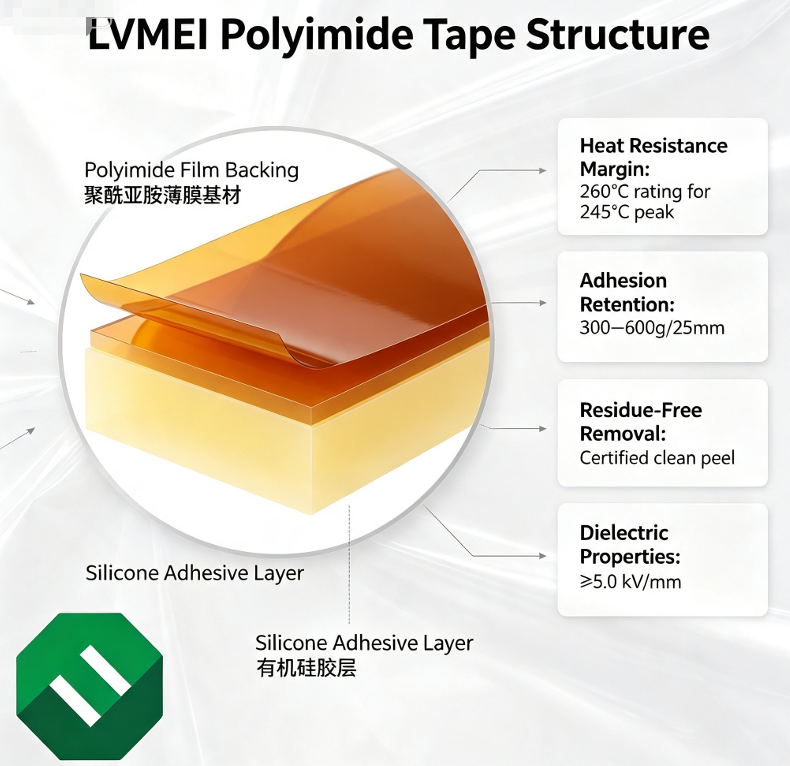
Polyimide tape is engineered specifically for these extreme conditions. LVMEI’s polyimide tapes utilize a high-quality polyimide film backing paired with a specialized silicone-based adhesive.
• Film Stability: The polyimide film can continuously withstand temperatures up to 260°C without shrinking or losing tensile strength.
• Silicone Adhesive: Unlike acrylic adhesives that can carbonize at high temperatures, silicone adhesives maintain their chemical integrity during the reflow peak, ensuring they do not chemically bond to the solder mask or gold plating.
• Dielectric Integrity: Polyimide maintains excellent dielectric strength even at elevated temperatures, preventing arcing during the reflow process.
Key Selection Criteria for SMT/Reflow Tape
When evaluating SMT high-temperature tape, buyers must look beyond the maximum temperature rating. Consider these four critical factors:
1. Heat Resistance Margin: Your tape’s maximum rating should be at least 20°C to 30°C higher than your peak reflow temperature. If your peak is 245°C, use a tape rated for 260°C.
2. Adhesion Retention: The tape must hold securely during the liquidus stage but release easily at room temperature post-cooling. Look for adhesion values between 300g/25mm and 600g/25mm for most SMT applications.
3. Residue-Free Removal: Post-reflow residue is a primary cause of PCB failure. Always demand residue-free certification.
4. Dielectric Properties: For high-voltage or sensitive RF applications, ensure the tape has a dielectric strength of at least 5.0 kV/mm.
Common Failure Modes in SMT Tape Application
Even the best tape can fail if misapplied or poorly specified. Watch out for these common issues:
• Edge Lifting: Caused by insufficient adhesion or improper surface preparation. Solder paste wicks under the tape, ruining the gold finger.
• Adhesive Residue: Usually caused by exceeding the tape’s thermal limit, using a degraded batch, or removing the tape while the board is still too hot. • Discoloration/Charring: Indicates the tape has exceeded its thermal threshold. The adhesive has broken down and may be conductive.
• Delamination: The adhesive separates from the film during reflow, leaving a sticky film on the PCB.
Application Best Practices To maximize the performance of your PCB masking tape reflow process, follow these guidelines:
• Surface Preparation: Ensure the PCB surface is clean, dry, and free of oils or dust before application.
• Firm Pressure: Apply firm, even pressure using a squeegee or roller. Silicone adhesives are pressure-sensitive; they require mechanical force to achieve full contact.
• Overlap Requirements: When masking large areas, overlap tape edges by at least 2mm to prevent solder wicking through microscopic gaps.
• Removal Timing: Always remove the tape after the PCB has cooled to near room temperature (below 40°C). Removing tape while hot can stretch the film and leave residue.
Product Recommendations for SMT Applications
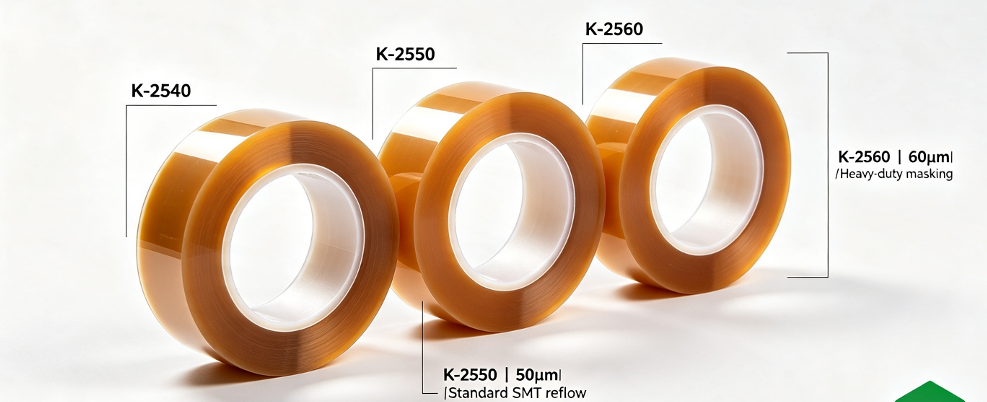
LVMEI offers a comprehensive range of polyimide tapes tailored for different SMT needs. Below is a selection guide:
Model | Total Thickness | Adhesion (g/25mm) | Best For |
K-2540 | 40μm | 300 ± 50 | General PCB masking, tight spaces |
K-2550 | 50μm | 400 ± 50 | Standard SMT reflow, gold finger protection |
K-2560 | 60μm | 500 ± 50 | Heavy-duty masking, wave soldering |
K-5080 | 80μm | 600 ± 50 | High-stress applications, irregular surfaces |
K-50100 | 100μm | 800 ± 50 | Extreme masking, high-voltage insulation |
Quality Verification Methods
Never accept SMT tape without verifying its performance. Implement these tests in your incoming quality control:
• Thermal Cycling Test: Expose the tape to three consecutive reflow profiles. Check for shrinkage, residue, and adhesion retention.
• Residue Test: Apply tape to a test coupon, run through reflow, remove at room temperature, and inspect under UV light or via solvent wipe test.
• Dielectric Withstand Test: Apply 1000V AC across the tape for 60 seconds; no breakdown should occur.
Troubleshooting Guide
Problem Probable Cause Solution Tape lifting during reflow Insufficient pressure or low adhesion grade Increase application pressure; upgrade to K-2560 Sticky residue after removal Exceeded temp limit or removed while hot Verify reflow profile; wait for board to cool Solder wicking under tape Poor surface prep or inadequate overlap Clean PCB surface; increase overlap to 2mm+ Film tearing during removal Removed too hot or tape degraded Ensure board is <40°C; check tape shelf life
Summary & Next Steps
Selecting the right SMT high-temperature tape is a critical decision that directly impacts your yield rate and product reliability.
By understanding the reflow profile, demanding rigorous quality verification, and partnering with a reliable manufacturer like LVMEI, you can eliminate masking-related defects from your SMT line.
Ready to optimize your reflow process?
LVMEI offers free samples of our K-series polyimide tapes for your evaluation.
Contact our engineering team today to discuss your specific SMT requirements, request a custom die-cut solution, or obtain a competitive quote. Visit lvmeikapton.com to learn more.